Traditional wisdom says: avoid overexposure. During several substrate evaluations I learned that this is not always true.
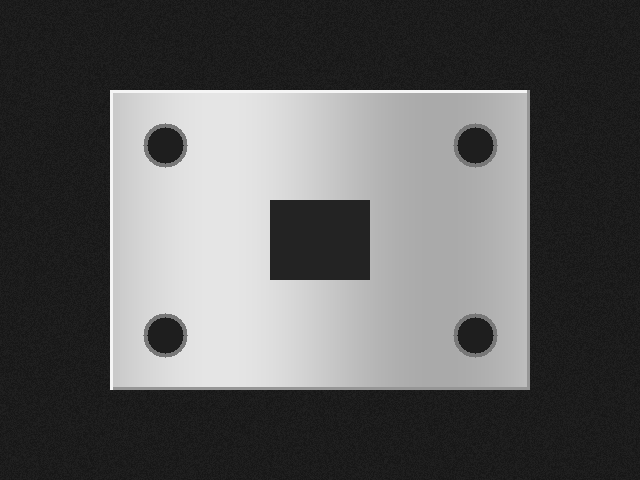
The idea
Certain defects only become visible when the image is intentionally driven into saturation. The defect changes brightness differently than the surrounding material, so pushing the exposure separates the two even though a "correct" exposure hides the difference.
The mechanism, with numbers
Imagine a defect that reflects 95% as much light as the surrounding metal. At a "correct" exposure the background sits at gray value 180 and the defect at 171 - a difference of 9 levels, easily lost in noise and texture.
Now quadruple the exposure. The background clips hard at 255. The defect, reflecting slightly less, lands around 250 or just below clipping - but more importantly, the texture noise of the background is gone, flattened to a uniform 255. The defect is now the only structure left in a perfectly clean field.
correct exposure:  background 180 +/- 8 noise, defect 171  -> ~1 sigma, invisible
4x overexposed:    background 255 (clipped),   defect ~248 -> clean 7-level gap, trivial
You did not create information - you used saturation as a nonlinear filter that erases the background.
How to apply it
- Find the exposure where the background just barely clips everywhere.
- Step exposure up from there and watch the defect-to-background separation, not the image aesthetics.
- Verify across multiple parts and batches - the technique depends on the background reflectivity being consistent.
- Keep a normally exposed frame in the same sequence for everything else you need to inspect.
Where it helped
- Conductive-substrate inspection where defects and background were nearly identical at normal exposure.
- Ceramic substrate evaluations with subtle surface differences.
Caveats
- Blooming and smear: on some sensors, heavily clipped regions leak into neighbors. Test your specific sensor.
- Anything you need to measure must come from a non-clipped frame. Saturated pixels carry no gradient, so edges shift.
- If background reflectivity varies batch to batch, the clip point moves with it. This is the first thing to check when the technique stops working.
The takeaway
Exposure is not just about getting a pretty picture. It is a contrast control. Sometimes the "wrong" exposure is the one that makes the defect obvious.