While evaluating microscope systems, I realized that many commercial calibration targets did not cover the full range I needed. I wanted one target that could validate distortion, resolution, contrast, repeatability, and focus performance across several orders of magnitude.
The range I needed
- 5 um
- 2 um
- 1 um
- Sub-micron structures
What each pattern is actually for
- USAF resolution patterns - the classic three-bar groups answer one question: what is the smallest line pair this system resolves? Coarse but universally understood.
- Siemens stars - resolution as a continuous function rather than discrete steps. The radius where the spokes blur into gray gives the cutoff directly, and the shape of the blur reveals astigmatism: an elliptical blur zone means the system resolves better in one direction than the other.
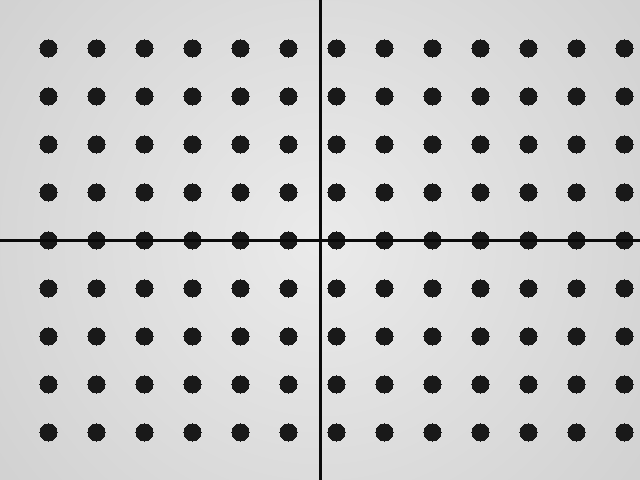
- Dot arrays - the workhorse for geometry. Fit the dot centers against the known grid and you get distortion, scale, and rotation in one measurement. Repeat the capture 50 times without moving anything and the spread of fitted centers is your true repeatability, optics and mechanics included.
- Distortion grids - dense line grids make distortion visible to the eye, which matters when explaining a lens problem to someone without a fitting pipeline.
- Alignment markers - crosshairs and L-marks so automated routines can find everything else reliably.
Proposed design
A fused-silica target combining all of the above, covering roughly 5 um down to the sub-micron range. Fused silica because the thermal expansion is roughly 30x lower than steel - the reference must move less than the thing being measured.
Design rules I follow
- Put fine structures in multiple field positions, not just the center. Lenses are always best in the middle; the corners are where they fail.
- Include features 2-3x smaller than the target resolution. A system should be tested past its limit, not just up to it.
- Pair every fine pattern with a coarse locator so automation can find it at low magnification first.
- Chrome-on-glass for transmitted or reflected use; never rely on printed targets below 50 um, their edge quality lies.
Why build instead of buy
A single target that exercises every property at once makes evaluation faster and more honest: you compare systems against the same physical reference instead of juggling several plates with different fabrication tolerances.