One of the biggest lessons in metrology is that the choice between 2D and 3D is not ideological.
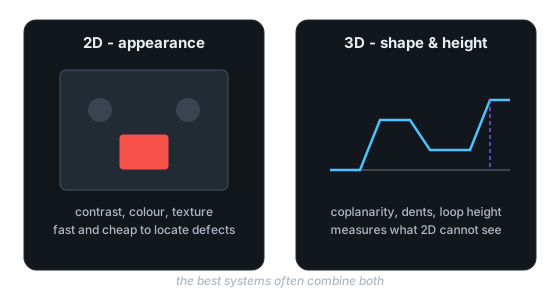
- Not every problem requires 3D.
- Not every problem can be solved with 2D.
- The best solution is often a combination of both.
How I decide
- If the defect is defined by appearance (contrast, color, texture), 2D is usually faster and cheaper.
- If the defect is defined by shape or height (coplanarity, dents, bond loops), you need 3D.
- Many real systems use 2D to find candidates fast, then 3D to confirm or measure only where needed.
Two mini-examples
The dent that 2D could not prove
A stamped metal part had shallow dents - about 40 um deep over a 2 mm diameter. Under every 2D lighting geometry the dent appearance depended on surface finish, which varied by batch. Some batches showed dents brightly; others hid them completely. A laser triangulation profile measured the depth directly, independent of finish, and the problem ended. The defect was defined by height, so only a height measurement was ever going to be stable.
The contamination that 3D could not see
The same line later had a contamination issue: thin oily residue, optically obvious as a slight sheen, but with essentially zero height. The 3D sensor saw nothing - the surface geometry was perfect. A 2D camera with UV illumination caught it instantly. The defect was defined by appearance, so the height map was the wrong instrument entirely.
The same production line needed both answers within one year. That is the norm, not the exception.
The hybrid pattern that keeps recurring
- Fast 2D pass over the whole part - find everything suspicious, tolerate false candidates.
- 3D measurement only on the candidate sites - slow per site, but there are few sites.
- Final classification uses both: appearance from 2D, geometry from 3D.
This buys 3D confidence at close to 2D throughput. The integration cost is real - two sensors, two calibrations, one coordinate system - but it is usually cheaper than forcing either modality to do the whole job.
Combining modalities usually beats forcing one technique to do everything.