The wrong first question is "What camera should we buy?"
The better first question is "What problem are we solving?"
The requirement hierarchy
- Business requirement - what outcome does the organization actually need?
- Inspection requirement - what must be detected, measured, or classified, and how reliably?
- Hardware requirement - only now does it make sense to choose optics, lighting, and a camera.
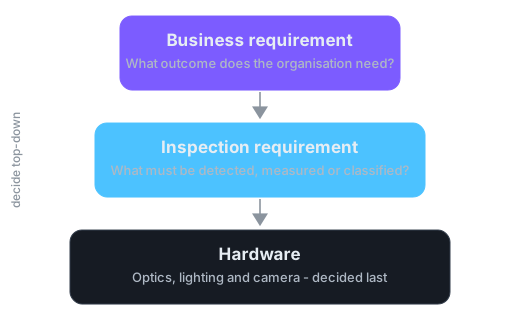
An example of each level
Using a coating inspection as an example:
- Business: stop shipping parts that fail in the field because of coating voids. Field failures cost roughly 100x the part value in returns and goodwill.
- Inspection: detect voids larger than 50 um on a matte coating, at 2 parts per second, with under 0.5% false rejects.
- Hardware: that detection requirement implies roughly 15 um per pixel sampling, a field of view that covers the part in one or two shots, and lighting that makes voids dark against the coating. Only now do specific lenses and cameras enter the conversation.
Notice that the hardware level was almost derived rather than chosen. When the first two levels are written down clearly, the hardware shortlist often picks itself.
The trap
Hardware is concrete and easy to order, so teams jump to it first. But hardware bought against an unclear requirement tends to be either over-specified (wasted money) or subtly wrong (wasted months). The cost of getting this backwards is almost always larger than the cost of the hardware itself.
I have seen a 25-megapixel camera purchased for an application that genuinely needed five. The extra pixels did not help - but they did quadruple processing time, force a more expensive interface, and push the cycle time over budget. The "best" camera made the system worse.
Signs you are in the trap
- The camera model is decided before anyone can state the smallest defect that matters.
- The justification for a component is "it is the best one" rather than "it satisfies requirement X".
- Nobody can answer "what happens if we miss one?" with a number.
- The spec sheet conversation is more energetic than the requirement conversation.
Understand the problem before buying equipment.