The fastest way to understand lighting is to image one difficult part under several geometries and compare honestly. This is a composite of several such studies on reflective metal-on-ceramic substrates - the kind of surface where every geometry has an opinion.
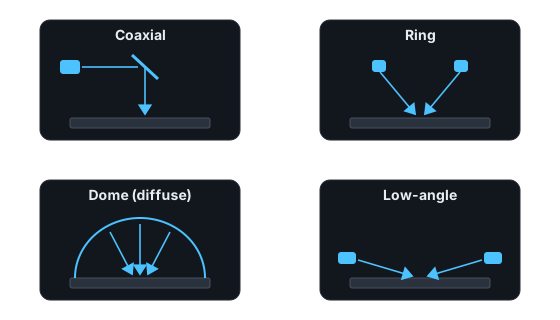
The test setup
Same camera, same lens, same part position. Only the lighting changes. The part carries four known defect types:
- A shallow scratch (topography, almost no reflectivity change)
- A discoloration patch (reflectivity change, zero topography)
- Edge chipping on the metal (both)
- Fine particle contamination (small topography)
For each geometry, the score is the worst-case contrast across all four defects - because production does not let you pick which defect arrives.
Round 1: coaxial
The discoloration patch jumps out instantly - reflectivity differences are exactly what coaxial sees. Edge chips show as dark outlines. But the shallow scratch is nearly invisible: its surface still reflects mostly straight back. Particles show only when large.
Strong on reflectivity, weak on topography.
Round 2: ring
The all-rounder result you would expect: everything is somewhat visible, nothing is excellent. The scratch shows faintly depending on its orientation relative to the ring segments. The discoloration is washed out compared to coaxial. The metal surface texture adds background noise everywhere.
Decent at everything, best at nothing. A fine place to start, a poor place to stop.
Round 3: dome
The smoothest, most even image of the four - and the most deceptive. Glare is gone and the discoloration is clearly visible against a calm background. But the scratch and the particles have almost completely disappeared: the dome's omnidirectional light fills in exactly the shadows that would have revealed them.
Beautiful images, hidden topography. Use it deliberately, never by default.
Round 4: low-angle
The drama queen. The scratch blazes like a lit fuse, particles light up like stars, edge chips are unmistakable. The discoloration, meanwhile, is gone - dark field shows almost nothing of flat reflectivity changes. And the background texture lights up too, raising the false-call floor.
Spectacular on topography, blind to flat defects, noisy everywhere.
The scoreboard
defect           coaxial   ring   dome   low-angle
scratch          poor      fair   poor   excellent
discoloration    excellent fair   good   poor
edge chip        good      fair   fair   excellent
particles        fair      fair   poor   excellent
No single geometry covers all four defects. That is the real result, and it repeats across almost every difficult part I have studied.
The conclusion
The question "which lighting is best?" has no answer. The question "which set of lightings covers all my defects, and what is the smallest such set?" always has one. Here, coaxial plus low-angle covers everything - two strobed frames, a few milliseconds apart, each one doing the job the other cannot.